
 Facebook
 X
X
 Pinterest
 Copy Link
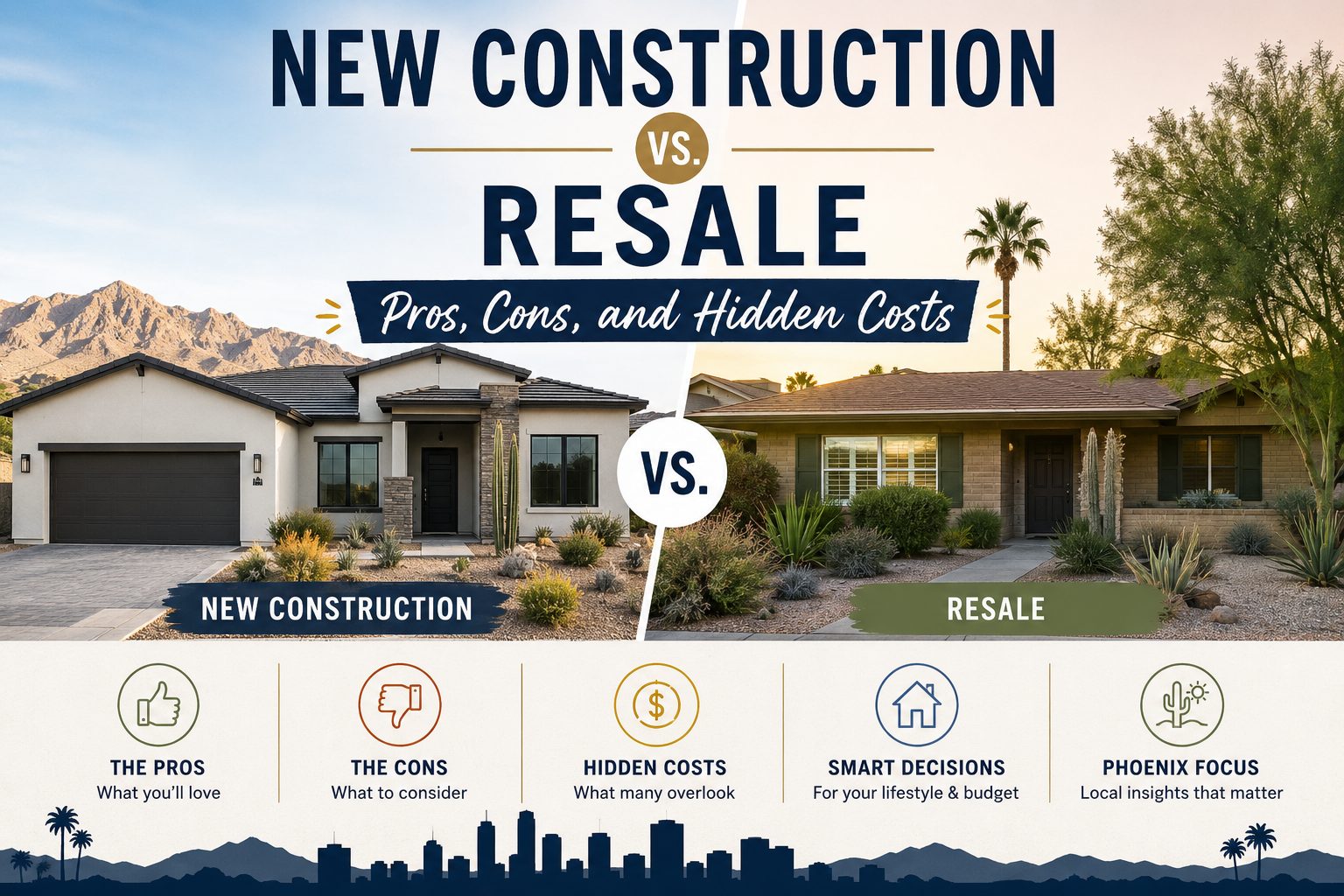
PHOENIX BUYER GUIDE | MAY 2026
New Construction vs. Resale in Phoenix:
Pros, Cons, and Hidden Costs
Both paths have real advantages in today’s Phoenix market — but the one that’s right for you depends on far more than the list price.
If you’re shopping for a home in the Phoenix metro right now, you’ve probably noticed something: you have real options. After years of frenzied bidding wars and vanishing inventory, today’s market has shifted. Prices have moderated, inventory has climbed, and builders are competing for your attention with incentives that weren’t on the table two years ago.
That means the new construction vs. resale question is more relevant — and more nuanced — than ever. Here’s what you actually need to know before you decide.
WHERE WE ARE RIGHT NOW
The Phoenix market in 2026 at a glance
| $460K
Median sale price (March 2026) |
51 days
Average days on market |
64%
Of sales closing below asking price |
This is a buyer-friendly window. Homes are sitting longer, sellers are negotiating, and builders are offering rate buydowns and closing cost credits to move inventory. That context shapes everything below.
SIDE BY SIDE
New construction vs. resale: the core tradeoffs
| New Construction | Resale Homes |
| ✓ Modern layouts, energy-efficient systems, smart home features | ✓ Established neighborhoods with mature trees and character |
| ✓ Builder warranties (1-2-10 year coverage) | ✓ Closer to employment, dining, and amenities |
| ✓ Incentives: rate buydowns, closing cost credits, appliance packages | ✓ What you see is what you get — no timeline uncertainty |
| ✓ Customization before build completion | ✓ More room to negotiate on price, concessions, and repairs |
| ✓ No immediate repair or upgrade costs | ✓ Often larger lots in desirable central locations |
| ✗ Located further from employment centers | ✗ Older systems may need attention (HVAC, plumbing, roof) |
| ✗ Builder contract protects the builder — not you | ✗ Compartmentalized layouts; renovation is costly |
| ✗ No mature landscaping; bare lots and unfinished community feel | ✗ No builder warranty — inspection is critical |
| ✗ Timeline risk — delays happen | ✗ Less energy efficiency in older builds |
WHAT BUYERS OFTEN OVERLOOK
The hidden costs on both sides
The purchase price is just the beginning. Arizona homeowners spend substantially more than most buyers anticipate once you account for the full cost of ownership. Here’s what to budget for on each path.
| Worth knowing:
A Bankrate study found that annual hidden homeownership costs in Arizona average over $21,000 per year when factoring in maintenance, insurance, utilities, and taxes — roughly 5-6% of a home’s value annually on a $450K purchase. |
| New Construction — Hidden Costs | |
| HOA Fees | Nearly every new community in Phoenix has an HOA. Gated or amenity-rich communities carry higher dues. Watch for one-time community enhancement fees or capital improvement fees at closing — separate from the monthly dues cap. |
| Landscaping | New builds typically deliver bare dirt. In the Phoenix heat, establishing grass, plants, and shade trees is a significant upfront cost — and ongoing if your HOA has landscaping standards. |
| Upgrade Costs | Builder base prices rarely include the finishes shown in the model home. Flooring, countertops, cabinetry, and fixture upgrades at the design center can add tens of thousands of dollars. |
| Lot Premiums | Corner lots, cul-de-sacs, or homes backing to open space carry a premium. This is negotiable on inventory or spec homes — but it’s rarely advertised as optional. |
| Builder-Preferred Lender | Builders push their in-house lenders. Their incentives can be real — but so can their fees. Always compare the full loan estimate, not just the rate buydown, before committing. |
| Property Taxes / CFDs | New communities in the outer metro may include Community Facilities District (CFD) assessments on top of base property taxes — often used to fund roads, utilities, and infrastructure. |
| Resale Homes — Hidden Costs | |
| Deferred Maintenance | HVAC, roofing, water heaters, and plumbing all have lifespans. Budget 1-2% of purchase price annually for maintenance on homes over 15 years old. |
| Insurance | Premiums in the Phoenix metro have risen. Pool ownership, roof age, proximity to desert areas, and home age all factor in. Get an insurance quote before you close. |
| HOA Resale Documents | Arizona law requires HOAs to provide specific documents to buyers during escrow. Document and estoppel fees range from a few dozen to several hundred dollars and are negotiated in the HOA addendum. |
| Special Assessments | If an HOA’s reserve account is underfunded, a special assessment can be levied — sometimes thousands of dollars per owner. Always review the HOA’s reserve study and financials during inspection. |
CRITICAL BUYER PROTECTIONS
What your agent needs to watch for in each scenario
| New construction — important:
The sales agent in the builder’s model home represents the builder, not you. Having your own buyer’s agent at your first visit — before you sign anything — costs you nothing and protects your negotiating position, inspection rights, and earnest money. |
Builder contracts are written to protect the builder. Key items to scrutinize include escalation clauses (which can increase your price if material costs rise), earnest money forfeiture terms, and what happens if the project is delayed or modified.
For resale homes, the Arizona purchase contract includes a standard inspection period during which you can negotiate repairs or credits — or walk away. In today’s market, sellers are often willing to negotiate, and a thorough inspection protects you from inheriting deferred maintenance you didn’t price in.
THE LOCATION QUESTION
Where new construction actually is in Phoenix right now
As land costs rise, most affordable new construction in the Valley is concentrated on the outer edges of the metro — Queen Creek, San Tan Valley, Buckeye, and Maricopa. For buyers working remotely or retiring to the Valley, this works well. For buyers tied to employment in Scottsdale, Tempe, or Central Phoenix, the daily commute math becomes a real factor.
Resale homes in established corridors — Arcadia, Tempe, Chandler, central Scottsdale — offer proximity to employment and amenities that most new communities simply can’t match at a comparable price point.
BEFORE YOU DECIDE
Questions to ask yourself
- Where do you work — and what’s your real tolerance for a longer commute?
- Do you have cash reserves for landscaping, upgrades, or deferred maintenance after closing?
- Is the builder’s rate buydown actually better than a competitive mortgage on a resale home, when you compare total loan costs?
- Have you reviewed the full HOA budget, reserve study, and CC&Rs — not just the monthly dues?
- For new construction: what happens to your earnest money if you need to back out?
- Are you comparing list price only — or total monthly cost including HOA, taxes, and insurance?
| The bottom line:
Neither path is universally better. New construction offers warranties, efficiency, and builder incentives — but comes with contract risk, location tradeoffs, and real hidden costs. Resale offers character, location, and negotiating leverage — but requires due diligence on systems, HOA health, and true cost of ownership. The right choice depends on your timeline, budget, and lifestyle — not the model home. |
Have questions about your search in the Phoenix metro?
I’m happy to walk through the numbers with you — no pressure, just straight answers. If you would like to discuss call or text 602-463-4521
